💡 Theory
/
🌌 World and Universe

Are we living in a closed world?
Are we living in a closed world? Discover the difficulties of communication and interaction in modern society, as well as how openness can change our perception of the world.
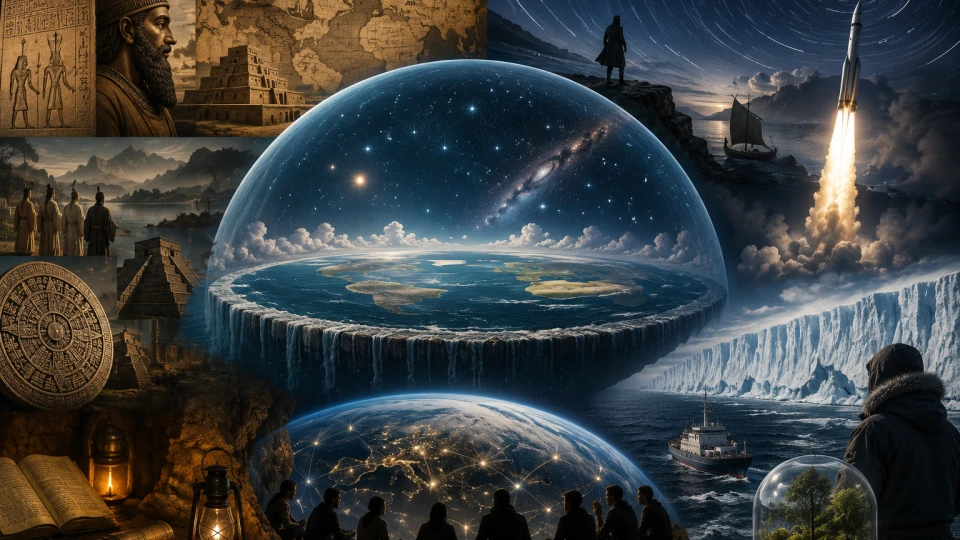
Since ancient times, the views of the world among most civilizations have been remarkably similar. They were based on the cosmology of a flat Earth. Ancient Chinese, Indians, Sumerians, Chaldeans, Jews, Egyptians, Babylonians, Greeks, Vikings, and Maya - all described the Earth as a flat surface over which the celestial vault is located.
These ideas existed more than five thousand years ago. A similar worldview is mentioned in the Book of Genesis - the first book of the Torah and Tanakh.
“And God said: Let there be a firmament in the midst of the waters, and let it divide the waters from the waters... And God said: Let there be lights in the firmament of the heavens to divide the day from the night, and let them be for signs and seasons, and for days and years. And let them be for lights in the firmament of the heavens to give light on the earth. And it was so.”
Here the term “firmament” is used. In ancient times, it was understood literally - as a solid structure in which the stars are fixed. Similar descriptions are found in other ancient texts, including the Book of Enoch, which also mentions a flat Earth.
Based on these sources, one can assume that our ancestors envisioned the sky as a kind of solid protective shell. In Jewish tradition, the celestial vault was regarded precisely as a physical object located above the Earth.
Ancient Jewish writings say:
“From the Earth to the first firmament - the distance is five hundred years of travel. The thickness of the firmament itself is also five hundred years of travel. Between each of the seven firmaments is the same distance.”
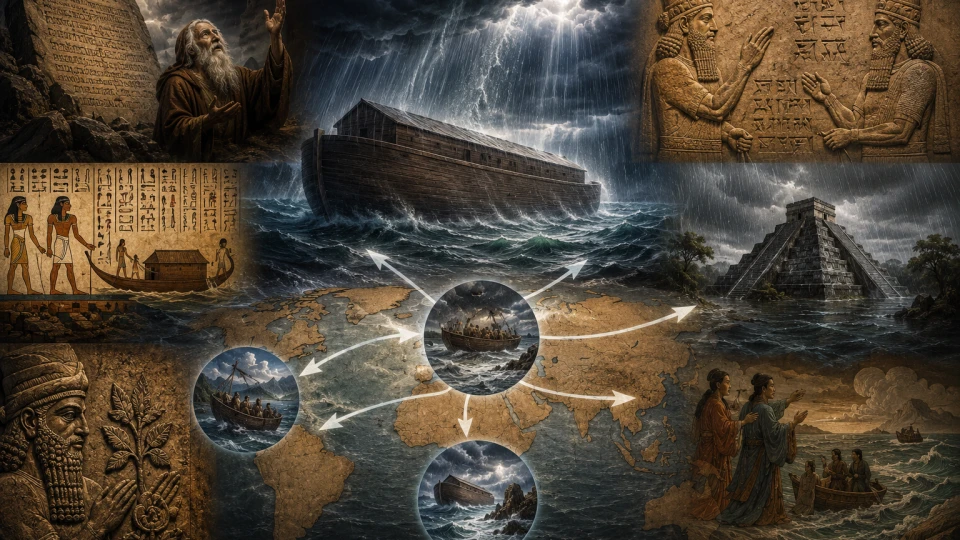
In the times of Noah, according to the biblical narrative, water poured onto the Earth from the heavens. The story of the Great Flood has left a deep mark in the memories of peoples. Anthropologists note that accounts of great floods are found in cultures around the world.
Interestingly, the word “heavens” is used in the plural. For some researchers, this serves as a reason to suggest the existence of multiple celestial levels or vaults.
If one considers the atmosphere as a closed system, then the distribution of gases into layers makes certain sense. This is certainly not proof of any ancient model of the world, but it raises questions.
The layer of stars that we observe at night also remains a subject of contemplation. Is it possible that it is arranged differently than is commonly believed? Some pay attention to the recurring celestial cycles and suggest that the observed picture may have a different nature. We cannot say with certainty whether what we see consists solely of physical objects or if there are other, currently unknown phenomena involved. However, one thing is certain - the sky is filled with energy that modern science can record and measure.
If one imagines that there is some kind of dome above the Earth, the question arises: is it possible to go beyond its limits? When rockets are launched, we always observe their takeoff, but rarely can we trace the entire path to the supposed exit into space in real-time. For some, this is just a filming peculiarity, for others - a reason to ponder.
Mysteries abound. What lies beyond Antarctica? Is it just a continent or something more? Where does our known world end? For now, these questions remain unanswered.
An interesting analogy can be drawn with the closed ecosystem created by David Latimer inside a glass bottle. If a person is capable of creating a self-sustaining environment for life, some question whether our entire world could be a similar system created by God the Creator.
Today, thanks to the telecommunications era, people around the world are connected by underwater internet cables. We can freely exchange information, discuss various hypotheses, and seek answers on our own.
It is important to remember: only study, research, and analysis allow us to get closer to understanding the surrounding world. Every person must draw their own conclusions based on the facts available to them and their own reflections. This is how a worldview is formed - when conclusions are born from observations of reality, not the other way around.
👁 67 просмотров
💬 0 комментария