QRazy
questions worth discussing
💬 Discussion / 🚀 Future

A Little About NASA's X-59 QueSST Aircraft

Learn about NASA's X-59 QueSST – a revolutionary aircraft designed to study supersonic flight with minimal noise. Discover its unique technologies and potential impact on the future of aviation.
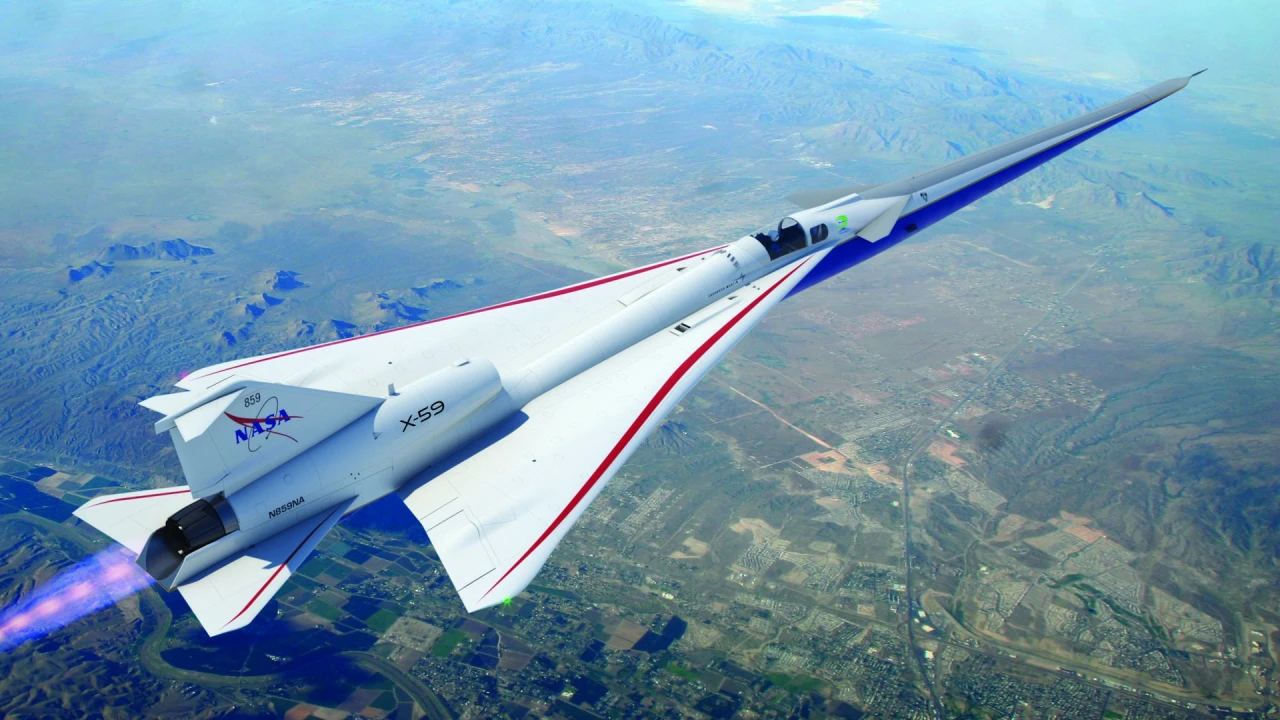
Иллюстрация с древними символами для обсуждения
Медиа-вопрос о древних символах и возможных инструкциях
This is an experimental aircraft capable of flying faster than the speed of sound, but it does so much more quietly. This is important because thanks to such technologies, supersonic passenger flights could become a reality again.

Once, the "Concorde" allowed passengers to fly from New York to London in less than three and a half hours. However, its operation was discontinued, partly due to the powerful sonic boom generated when flying at supersonic speeds. Because of this, supersonic flights over land have been banned in many countries.

The X-59 has an unusual design: a long pointed nose, wide triangular wings, and a T-shaped tailfin. This aerodynamics allows the aircraft to distribute shock waves so that they are much weaker.

In addition, the special shape of the lower fuselage directs most of the shock wave upwards. As a result, instead of a loud bang, only a muffled sound is heard on the ground, comparable to distant thunder.

During a recent test flight, engineers checked the aircraft's maneuverability and how it handles loads at high speeds. If the tests are successful, the X-59 technology could pave the way for the return of quiet supersonic passenger flights.

💬 Discussion / 🚀 Future

What will life be like for a person in 50 years?

What will a person's life look like in 50 years? Discover the technological, social, and environmental changes that will shape the future and how they will impact daily life, health, and the environment.

Иллюстрация с древними символами для обсуждения
Медиа-вопрос о древних символах и возможных инструкциях
I found a thread called "Future" on this site and realized that we can fantasize and discuss a lot here. After all, the future can unfold in various ways, so I decided to write down my thoughts.

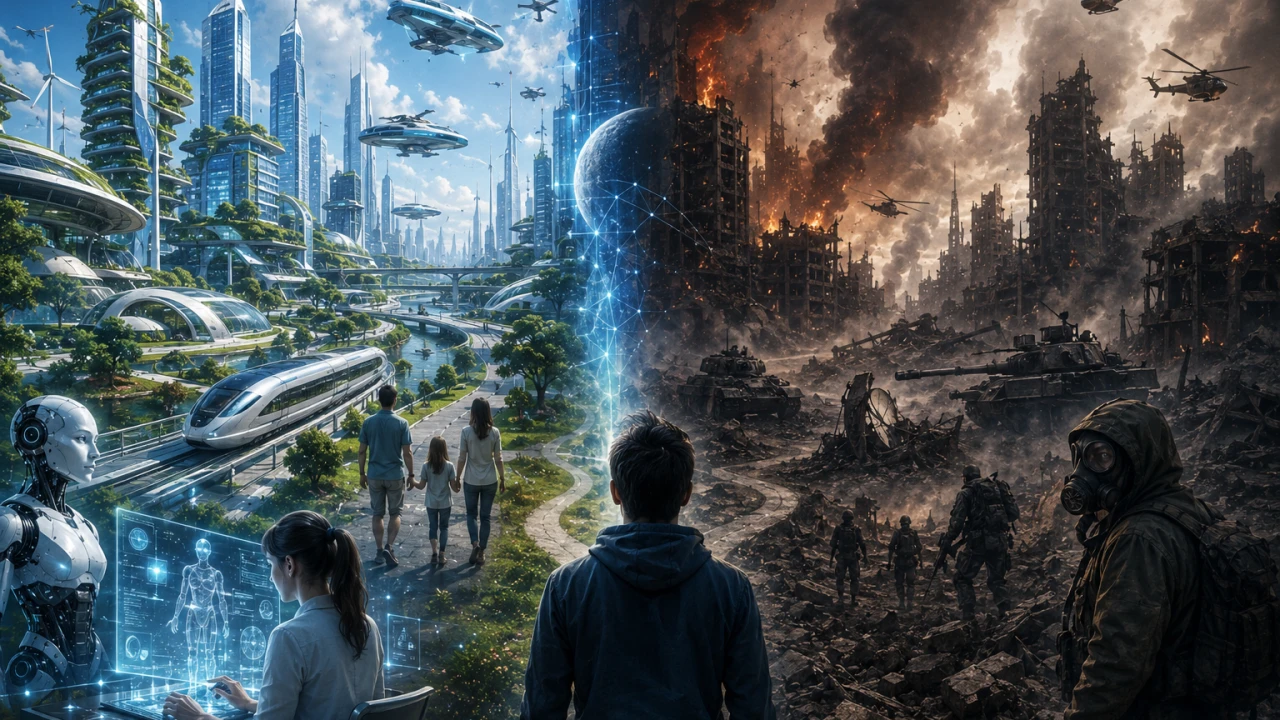
Three Possible Scenarios for the Future


It seems obvious to me that there are three main outcomes for the future. Let's fantasize 50 years ahead.

The first option is the most positive. Humanity will actively develop, make new discoveries, create new technologies, and everything will move forward.

The second option is less positive — humanity will find itself in a kind of stagnation, with no noticeable development and no serious regression. Of course, this is unlikely, but such a scenario is also possible.

The third option is the worst. Wars or global cataclysms could lead humanity to degradation. Why do I say that such things may have already happened? Because it remains unclear where some civilizations, which seemed highly developed for their time, disappeared to. History of what happened before them has also been lost.

A Scenario of Rapid Human Development


I don't even want to discuss the second option in detail, as it seems unlikely to me. But the first and third ones deserve attention.

The scenario in which humanity starts to rapidly develop has both good and bad sides. After all, new developments and discoveries can be used for both good and for war. But for now, let's consider the positive scenario.

There is a hypothetical theory called Technological Singularity, proposed by programmer and science fiction writer Vernor Vinge. It states that technological development will become so rapid and complex that it will become uncontrollable by humans. He even predicted the timeframes when this could happen, and we currently live in a period that many associate with the beginning of such processes.

We are already seeing how artificial intelligence is developing. Its progress is so fast that it becomes difficult for people to keep up. AI already performs a large part of the work that only humans used to do. If everything continues to develop at such a pace, then according to Vernor Vinge's assumptions, a significant breakthrough in AI may occur between 2027 and 2030, and full singularity could happen around 2045.

And if we look at what's happening today, it seems that we really are moving in that direction.

Based on everything we see, it is quite possible that in a few decades people will not understand how many technologies work anymore. Most tasks may be performed for us by AI, robots, and automated systems. On one hand, this is good, but on the other — such technologies can also be used for darker scenarios.

Moving to the Worst Scenario


The worst scenario is that we may not reach technological singularity at all. Or the singularity itself could lead to severe consequences for humanity and destroy much of what humans have created over centuries.

Right now we see wars and destruction. During major conflicts, scientific laboratories, infrastructure facilities, communication systems, and even parts of the global internet can be destroyed. All this can set humanity back by decades.

If wars become even more widespread, humanity might even annihilate itself. In that case, civilization may vanish just as other civilizations possibly have in the past.

What’s the Conclusion


Therefore, the forecast for 50 years ahead remains extremely unpredictable. We can build theories, assume various scenarios, and fantasize, but no one knows for sure what the world will be like in half a century.

So, we can only discuss and reflect on the future. Which is what I propose all of us do.

Loading...
Ask uncomfortable questions

Discuss controversial topics and theories.

Compare arguments and opinions.

Compare arguments and opinions.

Top comments rise due to votes.

Top comments rise due to votes.

Consultant Online