
Loop Engineering — the next stage of AI agents' evolution
Discover Loop Engineering — a new phase in the evolution of AI agents that transforms the approach to artificial intelligence and changes the game in technology.
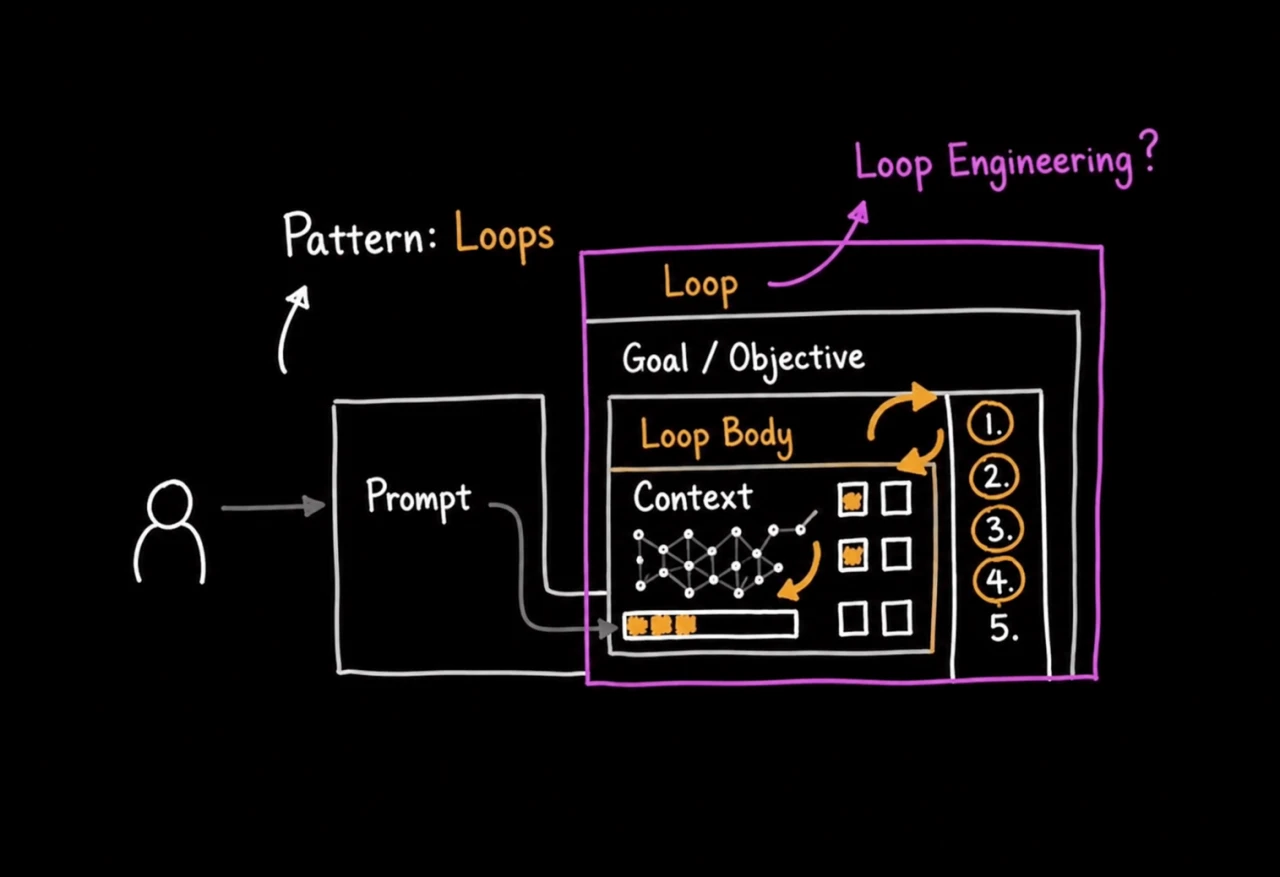
We have a new term in AI — Loop Engineering.
I have figured it out and I will try to explain what it is in simple words.
From Prompt Engineering to Context Engineering
First, there was Prompt Engineering — when we wrote instructions directly to the models.
“You are a polite customer support agent. Help my clients.”
After that, the model plays the assigned role and answers using its own knowledge.
The next stage was Context Engineering.
Now the prompt itself is just a small part of the contextual window. What is much more important is what surrounds it. The context can include documents, search results, files, chat history, data from databases, and much more.
That's why modern agents are given access to tools: files, web pages, APIs, and databases.
For example, if we ask:
“What is NASA's latest discovery?”
The agent will first independently find fresh information, gather the necessary context, and only after that formulate an answer.
Why Harness Engineering is Needed
But it quickly became clear that Context Engineering struggles with long tasks that take dozens of minutes or even hours.
The context gets overloaded. The agent begins to compress it to fit within the token limit, and along with the compression, important details are gradually lost.
That’s why another level appeared — an external mechanism for task management.
This is Harness Engineering.
Harness is a system that takes a large user request, breaks it down into multiple subtasks, and helps the agent sequentially move from one task to another without losing the overall execution plan.
For example, if you ask Claude Code or Codex to completely clone the NASA website, just one context is not enough.
An external mechanism is needed to keep track of the task list, monitor progress, launch the next steps, and ensure that nothing is lost along the way.
What is Loop Engineering
Now let's pay attention to something interesting.
In all these approaches, there are already loops.
In Context Engineering, the agent repeatedly calls tools until it gathers all the necessary information.
In Harness Engineering, it goes through the list of subtasks until it completes all the work.
And here comes Loop Engineering.
It adds another layer on top of all the previous ones.
The main idea is to remove the dependency on a person who is constantly sitting in front of the computer sending new requests to the model.
Instead, an external loop appears that independently checks what has changed, what new tasks have emerged, and whether to continue the work.
An Example with a World Cup Website
For example, the World Cup is currently underway and we ask Codex to create a website dedicated to the tournament.
Prompt, Context, and Harness will help build this website.
But matches are happening every day. Results are constantly changing. This means the site needs to be updated regularly.
This is where Loop Engineering comes into play.
We set a loop:
“Check new match results every hour, update tables, fix errors, publish changes, and keep working.”
In other words, the agent does not wait for a new command from the user — it periodically returns to the task and keeps it up to date.
The Transition from Manual Prompting to a System
There is a great post by Eddy Osmani dedicated to Loop Engineering.
He describes this approach as a transition from manual prompting to system design, which independently launches agents, sets them goals, evaluates progress, and repeats the cycle until the desired result is achieved.
In my opinion, the easiest way to try Loop Engineering today is through Scheduled Tasks in Codex or Claude Code.
Yes, this approach is often criticized. The main argument is that continuous loops can consume a huge number of tokens.
But at the same time, Loop Engineering significantly expands the application range of AI agents.
We are gradually shifting from the model of “reply to my request” to the model of “continuously work on my task”.