
Supremacy of Balance: Why Equilibrium Remains the Main Law of the World
"Discover why balance and equilibrium are fundamental laws of the world. Dive into the philosophy and practical significance of the Supremacy of Balance for harmony in life and society."
We are used to dividing everything into black and white, good and bad. In our society, the main force is considered to be aggression, active action, and victory at all costs. But life shows otherwise: every extreme eventually disappears. And however great the power may be, sooner or later it perishes. This is how the only important law of the world is maintained — balance.
This law has been in effect since the creation of the world. Its fundamental principles can be seen everywhere: in nature, society, the lives of cities and countries. It seems that the planet itself has carefully thought out the rules of its existence and gently removes everything that can create distortions.
This unshakeable rule can be confirmed by examples from nature, in which all processes are strictly interconnected and interdependent.
Balance in Nature
Example 1. Balance of Oxygen and Carbon Dioxide
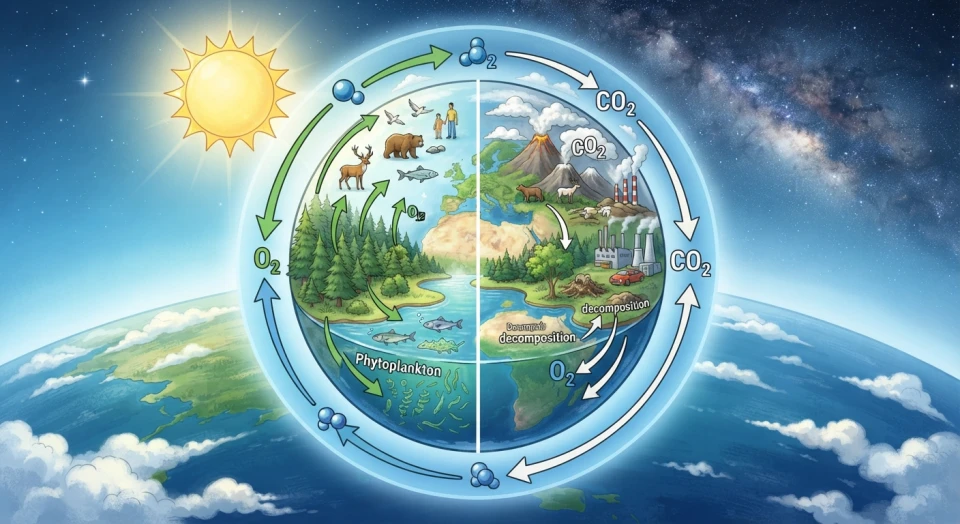
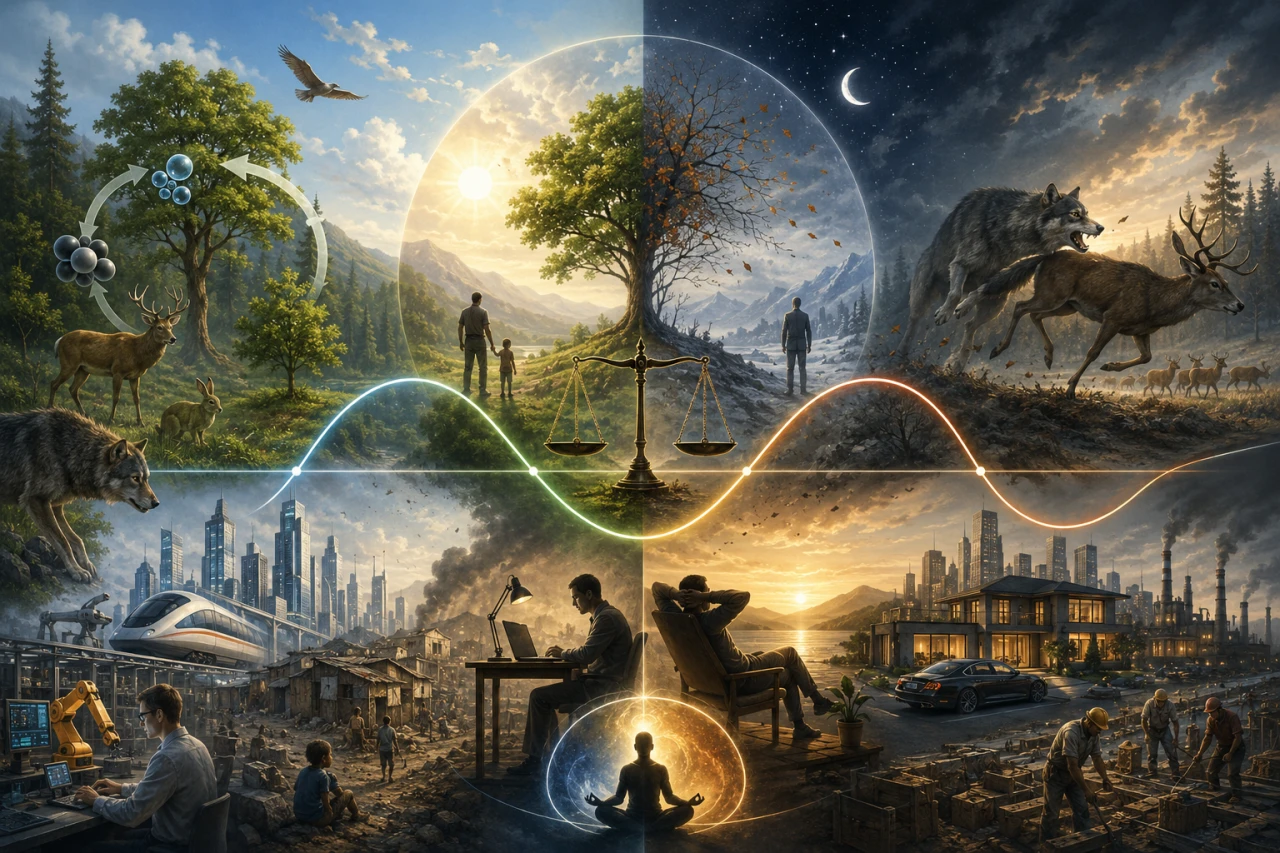
Oxygen is essential for the life of all living beings. All living organisms on the planet, including humans and animals, breathe air, which contains oxygen. In return, they emit carbon dioxide, which is necessary for trees and other vegetation. By absorbing carbon dioxide, trees release oxygen into the environment.
This simple yet meticulously refined scheme clearly demonstrates how natural balance is maintained. Living organisms need trees, while trees require the life products of those organisms. That’s why in deforested areas, young trees can be seen within a year, even if humans did not plant them. Nature itself finds ways to eliminate potential threats and maintain the unity of the system.
Example 2. The Change of Day and Night, the Periodicity of Seasons
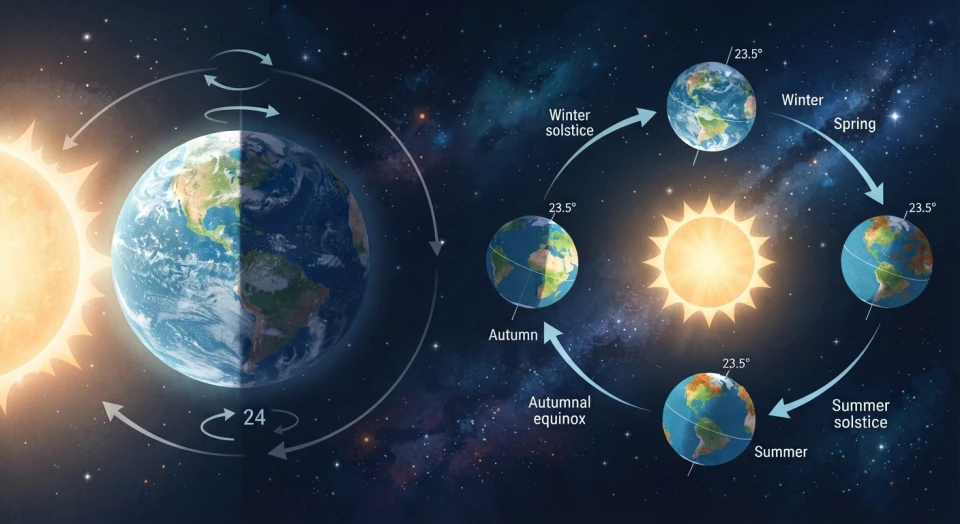 The Change of Day and Night, the Periodicity of Seasons
We are used to the idea that night is followed by day, and after winter comes spring. But if we think about it, this periodicity is extremely important for sustaining life on the planet. Plants need light for growth and development; however, constant sunlight is detrimental to all living things. Even humans are designed such that their bodies require a long night’s sleep: during this time, they recover and regain strength.
The change of seasons maintains natural biological processes. Trees, animals, and insects go into "hibernation" — they enter a state of deep sleep, so that in spring, replenished with energy, they can wake up and continue living. However, the most vulnerable organisms do not survive cold periods: dead trees finally crumble, while sick and weak animals inevitably perish.
Thus, this alternation of opposites is created for the sole purpose of ensuring balance in nature, eliminating the excess and hopeless.
Example 3. The Balance of Predators and Herbivores in Nature
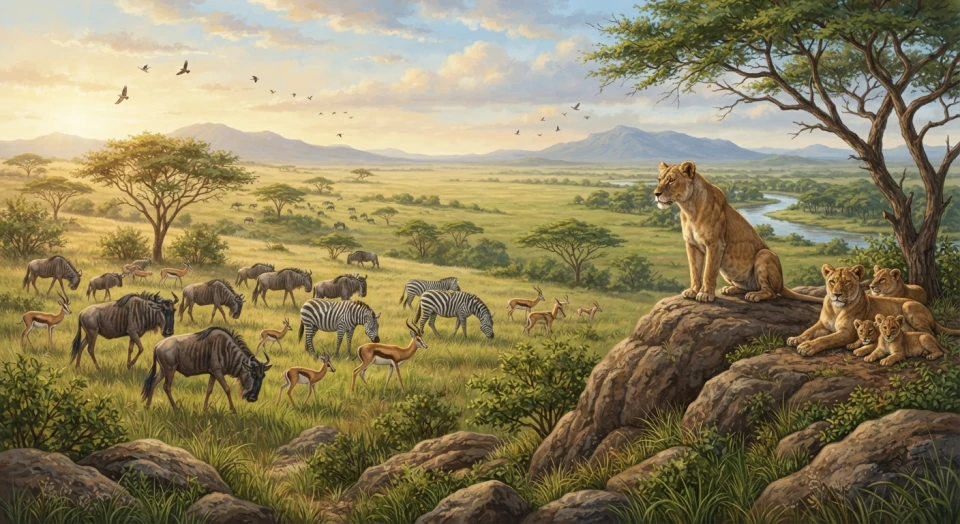 The Balance of Predators and Herbivores in Nature
The extermination of deer, hares, and other animals by wolves can be perceived as brutality and a manifestation of the dominant strength of the predator over the prey. But here it is important to understand that large populations of herbivores destroy vast areas of vegetation.
Without control over their numbers, mass deaths will begin in forests and fields — from insects to birds. New grasses and bushes will simply fail to grow, and soon the territory will turn into a lifeless desert.
Predators act as the sanitizers of the forest. They kill weak and sick animals, and also prevent herbivore populations from reaching a level that would be dangerous for nature. Thus, predators maintain the health of the entire ecosystem and preserve the balance needed for the continued existence of the environment we are accustomed to.
Balance in Human Life and Society
The law of balance is observed not only in nature but also in human life.
This is evidenced by numerous examples from the past and present of our civilization, as well as many processes we consider part of everyday life.
Example 1. Progress is Impossible Without Stagnation
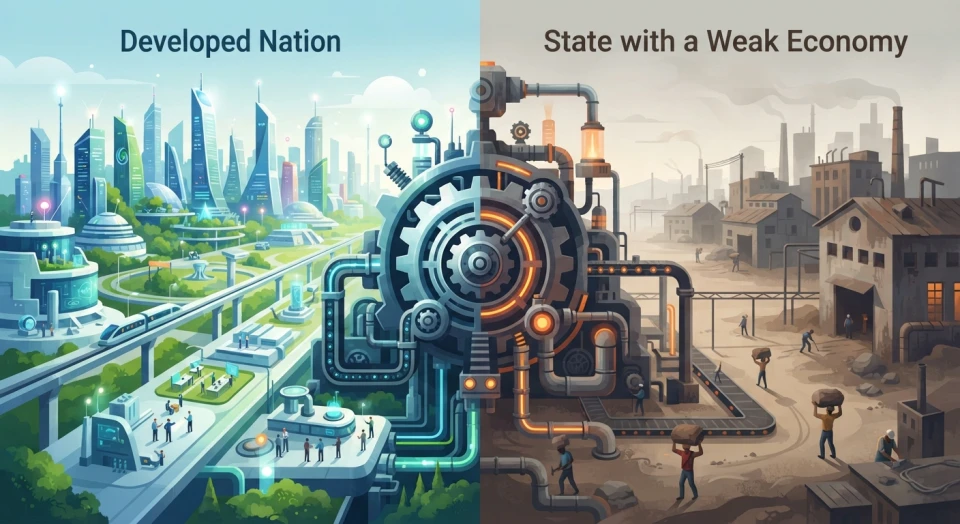 Progress is Impossible Without Stagnation
Technologies make human life more convenient and simpler. However, alongside highly developed countries, many states with stagnant economies still exist in the world. These countries generally become the primary market for sales and locations for production. Thus, people from poorer regions gain the opportunity to earn and acquire the benefits of the modern world.
At the same time, analyzing their way of life and needs creates the prerequisites for new ideas and technologies. This is how many modern achievements of humanity have emerged — from electricity to cars. Great discoveries often occurred against the backdrop of ruin and stagnation. This close interdependence persists to this day.
Example 2. Wealth Can Only Exist Alongside Poverty
 Wealth and Poverty
Wealth is a rather relative concept. A person can only be considered rich in the presence of poor people. Only by comparing the available benefits for one and the other category of the population can a boundary be drawn between them.
On the other hand, wealthy individuals are predominantly those who founded productions, large corporations, and companies. The activities of these companies are impossible without the labor of less fortunate people. It is on the labor of millions of ordinary workers that billion-dollar fortunes are built and grow. This clearly demonstrates how one part of society exists thanks to another.
Example 3. Alternation of Work and Rest
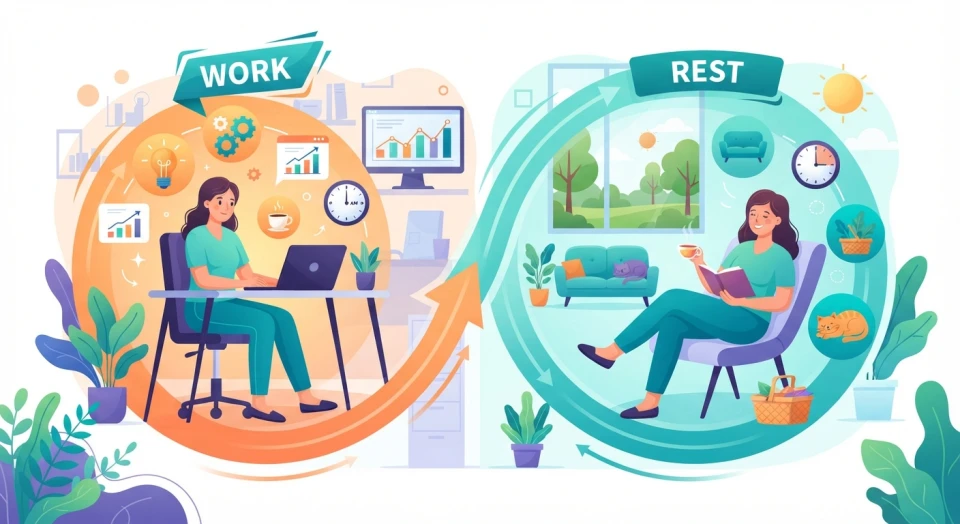 Alternation of Work and Rest
No person can work in a high-efficiency mode indefinitely. Over time, workloads exhaust the body, leading to feelings of fatigue — both physical and intellectual. The body actively signals the need for rest.
But constantly resting is also harmful. Idleness and laziness lead to stagnation. A person forgets the acquired knowledge, loses interest in what is happening, and as a result, does not develop but, on the contrary, degrades.
For a fulfilling and meaningful life, it is essential to alternate periods of stress and recovery. Muscles grow not during workouts, but after them — during recovery periods. The same happens with the brain: constant mental overload leads to fatigue and headaches.
By adhering to a regime of activity and rest, a person maintains good memory, clarity of thought, and high productivity. The conclusion is simple: any growth requires a balance between tension and relaxation.
Life is a Sine Wave
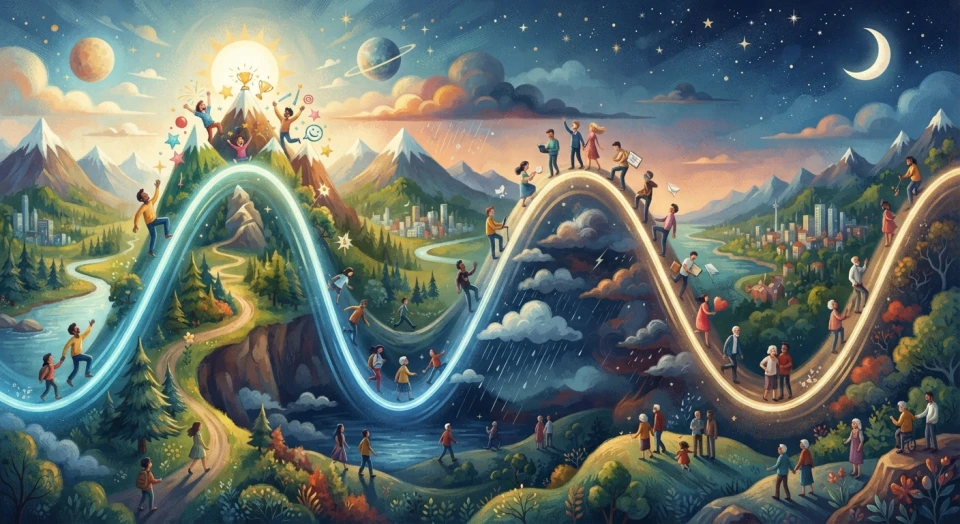 Life is a Sine Wave
If we combine everything mentioned above, it becomes clear why life can be compared to a sine wave. When one force begins to dominate over another, imbalance arises: for one side, a period of well-being begins, while for the other — a period of difficulties. However, such a state cannot last indefinitely. Upon reaching its limits, the system begins to strive for balance, and a turnaround occurs.
At this moment, life's "sine wave" changes direction. Those who previously enjoyed success begin to encounter difficulties, while those who experienced a rough patch gradually emerge from it. As they move towards the opposite peak, their situation improves, until a new period of well-being arrives.
This is why there is no permanent success or constant failures in life. Ups and downs replace each other, and after every downturn a new rise follows sooner or later. Life constantly strives for balance, developing through the alternation of opposite states, similar to the oscillations of a sine wave.
There are countless examples of the law of balance in action. But all of them will again prove a simple truth: processes in the world, in nature, and in our lives rely on the principle of maintaining balance. And as long as one side balances the other, the future can be reassured.