
The Economy of the Future: What Will Countries Sell When Robots Learn to Produce Everything
Discover how the economy of the future will change with the advancement of technology and manufacturing robots. What goods and services will be in demand from countries when automation shifts traditional industries?
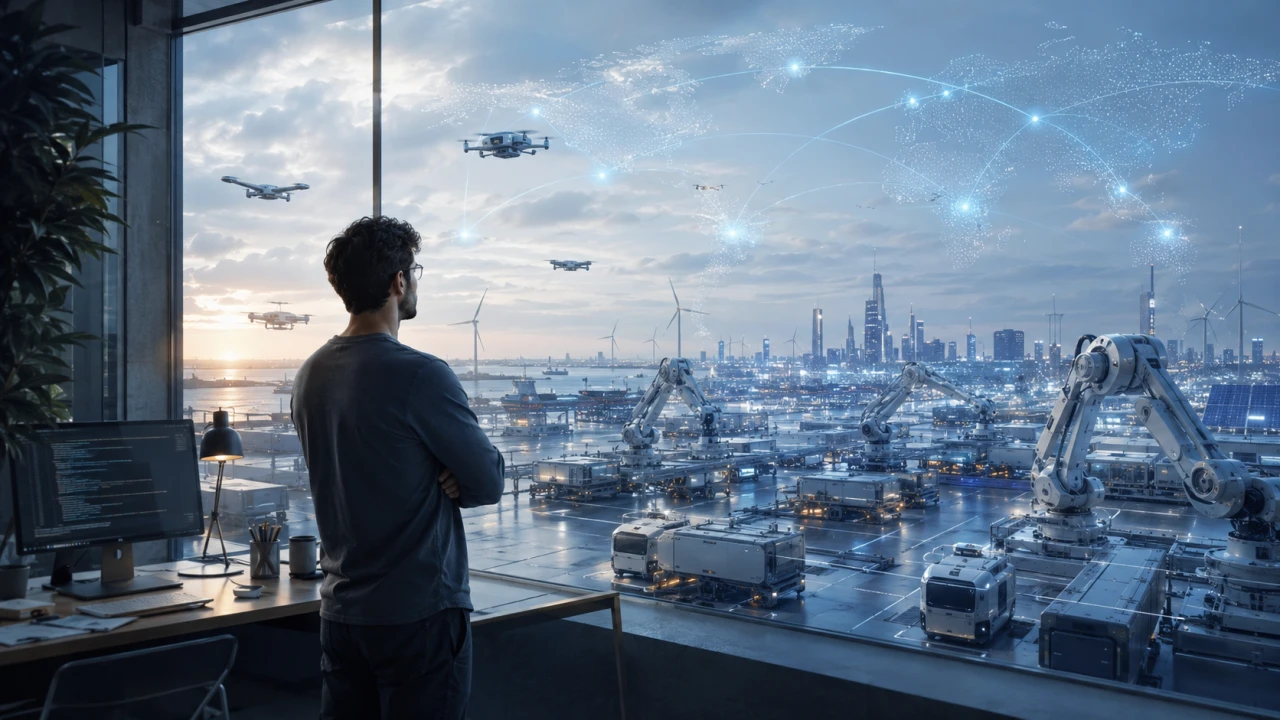
I am not an economist and I do not venture to make precise forecasts decades into the future. I am an ordinary IT specialist who observes the development of artificial intelligence and attempts to automate more and more processes every day. Hence the question: what will happen to the global economy if nearly every country has smart robots capable of designing and producing the same goods?
Currently, countries earn money based on what they can do better than others. Some extract oil, others assemble electronics, produce cars and medicines, or develop software. Many goods can be produced within a country, but it is often cheaper to buy them where there are existing factories, prepared specialists, and established supply chains.
International division of labor largely relies on this difference. If technologies gradually level the production capacities of countries, they will need to find new sources of income. The situation for people will change as well: when machines take over most of the work, the usual link between employment, wages, and consumption may cease to function.
Economy exists due to differences
International trade arises not only because people need goods. It is also important that producing them does not yield the same benefits in different places.
Somewhere, energy and labor are cheaper, while somewhere else there are rare natural resources. Some countries have accumulated engineering knowledge over decades, built ports and railways. Others have created strong universities and technological companies.
These differences turn into economic advantages. A country capable of producing complex microchips sells processors to those who cannot yet do so. A state with large gas reserves exports energy. Manufacturing of clothing and electronics is moved to places with cheaper labor.
Artificial intelligence can significantly smooth out some of these differences. It is already helping to write programs, design parts, analyze medical images, manage warehouses, and create new materials. As robotics develops, machines will take on more physical tasks.
At the same time, the dissemination of knowledge will accelerate. Manufacturing experience, which previously required years and thousands of specialists to accumulate, can now be transferred in the form of a model, digital project, or software package.
In a sense, manufacturing experience will become similar to a file that can be copied.
Natural resources cannot be replicated this way. But many engineering solutions can be.
Universal factory instead of separate plant
In a radical scenario, the automated factory of the future will resemble a gigantic universal printer.
Modern enterprises are usually designed for specific products. An automotive plant manufactures cars, a textile factory produces fabric, and a furniture factory makes furniture. Reconfiguring production is complicated and expensive.
A flexible robotic enterprise could assemble household appliances in the morning, make parts for agricultural machines in the afternoon, and produce medical equipment in the evening. Robots will change tools, artificial intelligence will calculate processes and reconfigure the line.
The main commodity in such a system will not be the product itself, but its digital description and access to the factory. The buyer will select a model of shoes, size and color, after which local production will make a pair on demand. There will be no need to produce a million identical sneakers on another continent, transport them across the ocean, and store them in warehouses for months.
The same could happen with furniture, spare parts, electronics, and some food products. A significant part of mass production will become local: goods will be made close to the buyer and only when they are genuinely needed.
- Long-distance transportation of finished goods will decrease.
- The need for huge warehouses will diminish.
- Production will adapt more quickly to specific orders.
- Local factories will be able to produce different categories of products.
What countries will continue to trade
Completely self-sufficient states will not emerge. Even a perfect factory does not create substance from nothing.
Production requires metals, water, energy, and chemical components. Robots need processors, and data centers require electricity and cooling systems. For batteries, lithium, nickel, graphite, and other materials will still be needed.
Trade will persist, but its focus may shift from finished products to resources and production capabilities. Countries will sell:
- energy and raw materials;
- computing power;
- artificial intelligence models;
- digital projects and industrial licenses;
- material recycling technologies;
- access to transport and space infrastructure.
Energy as an industrial advantage
Countries that can produce a lot of cheap electricity will gain a significant advantage. Their territory can host data centers, robotic factories, and energy-intensive enterprises.
Computations as a new resource
Calculations will become an equally important resource. The more complex the artificial intelligence, the more equipment is required for its operation. Computing power is often compared to new oil: without it, it will be difficult to manage production, finance, science, and government systems.
However, this comparison has its limits. Oil cannot be copied, but a software model can. Therefore, technology owners will control not only the programs but also the servers, updates, licenses, and terms of use.
Cheap production will not make goods free
If robots can produce things with almost no human involvement, the cost of many goods will fall. But that does not mean they will be free.
The price depends not only on costs but also on ownership, competition, and access. Suppose a robotic factory can assemble a smartphone cheaply. But the design system belongs to a private company and requires a license purchase. Robots work on a subscription, the operating system is paid separately, and cloud AI is only available within a certain tariff.
The device itself may be cheap, but it will be surrounded by digital restrictions.
Economy of artificial scarcity
The first signs of such a model are already evident. People buy devices but may not always be able to repair them themselves. They pay for software while effectively receiving temporary rights to use it. Some functions of a car are physically installed but are only activated after additional payment.
This could lead to an economy of artificial scarcity. Technically, the product is sufficient for everyone, yet access to it will be restricted by patents, licenses, subscriptions, and closed platforms.
The struggle will not be for the ability to produce an item, but for the right to do so.
Automation breaks the familiar monetary cycle
The majority of people earn money through work. Companies hire employees, who create goods and services, receive salaries, and spend them in other companies. This forms a cycle: people produce, earn, and buy what others have made.
Mass automation has the potential to break this chain. Robots do not require salaries. They do not rent housing, buy groceries, or shop. The income from their work goes to machine, program, energy, and infrastructure owners.
The fewer workers businesses need, the more wealth can accumulate with the owners of automated systems.
A paradox arises: factories produce more goods than ever, but a significant part of the population cannot afford to buy them.
This presents not only a social problem for the economy but also a practical one. Production makes sense as long as there is solvent demand. It is pointless to produce millions of cars when the majority of people cannot afford even one.
States will have to seek new ways to redistribute income, not only for the sake of fairness. Without buyers, an automated economy will simply cease to function properly.
Income may be separated from employment
Perhaps a person's wealth will become less dependent on the number of hours worked. This does not mean the complete disappearance of work. People will continue to engage in medicine, education, research, politics, creativity, caring for others, and managing complex systems. But the five-day work week may no longer be a prerequisite for a normal life.
Social dividend
One possible option is a social dividend. The state or a public fund owns part of the automated infrastructure and distributes profits among citizens.
Basic income and reduced workweek
Another option is a basic income not tied to employment. Transitioning to a reduced workweek is also possible: instead of one part of the population working 40 hours while the other remains unemployed, necessary tasks can be shared among a larger number of people.
Public computing power
Another model involves public computing power. The government provides citizens and small companies with access to AI, servers, and robotic production just like it currently provides roads, schools, and urban infrastructure.
This way, an individual can launch small-scale production or create a new product without needing to buy their factory. Economic freedom will be determined not just by money but also by access to automation tools.
Instead of separate items - entire systems
If an ordinary product can be easily copied, companies and countries will begin competing at the ecosystem level.
- Not just a robot, but a complete robot management system.
- Not a standalone AI model, but servers, updates, security standards, and development tools.
- Not a car, but a transport network with software, charging infrastructure, and autonomous navigation.
The advantage will go to those who once created a good product, and to those who turned their platform into the foundation for the work of others.
The digital economy is already structured similarly. Manufacturers compete not only with smartphones or computers. Stores for applications, payment systems, cloud services, and closed ecosystems emerge around devices. In the future, this principle will spread to factories, transport, and entire cities.
A country may independently produce almost any technology but will remain dependent on foreign artificial intelligence, updates, and industrial standards. The place of assembly will become less important than control over the software layer.
What cannot be copied will become more valuable
Even widespread technology adoption will not lead to complete equality. Some things cannot be reproduced endlessly.
A deposit of rare metal cannot be copied, cultivated fertile land cannot be expanded, and a second coastline cannot be created in the center of an already constructed city. Human time and attention, trust, reputation, security, and housing in desirable areas will remain limited.
Unique experiences and human relationships may become more valued. Artificial intelligence can create music in seconds, but a live concert will remain a special event. It can paint millions of pictures, however, the work of a specific artist may only become more valuable. A robot will prepare technically perfect dishes, but visitors will continue to choose restaurants with history, atmosphere, and character.
When identical items are available to all, differences become more valuable.
Therefore, the economy of the future will likely be not an economy of sameness, but an economy of uniqueness.
Mass-produced goods will be relatively cheap and will be produced automatically. Competition will shift to where origin, personality, status, culture, trust, and limited access matter.
Human participation will become a premium service
The more tasks are taken over by automatic systems, the higher the price for genuine human participation may become.
Today, customers often choose automated service because it is faster and cheaper. In the future, a conversation with a living doctor, teacher, consultant, or craftsman may turn into a premium service.
Restaurants where only humans cook, schools without digital teachers, and hotels without robots will emerge. Manual work will be purchased not necessarily for its objective superiority, but because it was done by a human.
Human as a sign of authenticity
This has happened before. Mass production made clothing cheap, but manual labor did not disappear – it moved into an expensive niche. Digital music is instantly accessible, yet vinyl records have returned as physical and emotional objects.
Automation does not always destroy old forms of production. Sometimes, it turns them into luxury.
In a world of perfect copies, the imperfect original becomes particularly valuable, and human participation becomes a sign of authenticity.
Technological independence will become political
In the 20th century, a state's independence largely depended on industry, military, and energy. In the 21st century, digital infrastructure has been added to these factors. The next condition could be self-sufficiency in AI and robotics.
If foreign platforms manage factories, hospitals, transport, and energy networks, formal independence guarantees little. The system owner can change terms, stop updates, or restrict access.
Thus, countries will likely establish national AI models, their own data centers, robotic platforms, and industrial standards. The world could split into several large technological zones with their programs, protocols, rules, and payment systems.
Digital borders of the future
Physical goods can be produced almost anywhere, but digital borders will become stricter. Instead of containers with finished products, countries will exchange models, projects, and computational tasks.
The customs of the future may check not trucks, but data streams.
The economy will not disappear - scarcity will change
The economy exists not because people like to buy and sell. The reason lies in the scarcity of resources and almost limitless desires.
Robots will lift some of the current restrictions. Production will become faster, cheaper, and more accessible, and many expensive goods today may turn into everyday items. But the disappearance of one scarcity will create another.
- Labor: less human labor will be required.
- Energy and calculations: demand for them will, in contrast, increase.
- Production: goods will be easier to manufacture.
- Platforms: control over digital infrastructure will become more difficult and important.
- Content: there will be more of it, while free attention will be scarcer.
- Technology: it can be copied, but trust, reputation, and uniqueness will remain limited.
The economy of the future will not abolish exchange. It will change its subject.
Today, the world sells things.
Tomorrow it may sell access - to energy, computing, robots, data, platforms, security, and audiences.
And the most valuable again will be that which cannot be automated completely: human time, personal trust, and the right to independently determine how your life is arranged.